News
The International Scientific Conference “ Albania and National, Ethnic and Cultural Minorities“
13-14 February 2013, Tirana / AlbaniaThe 100-th anniversary of the Albanian state offered a valuable opportunity to discuss on the issues revolving around the national, ethnic and cultural minorities that have established and live in the Albanian territory or those of Albanian communities living in the neighboring countries, due to historical and social events.
The goal of the International Conference “Albania and the National, Ethnic and Cultural Minorities” was to provide an analysis of the situation of national, ethnic and cultural minorities living in Albania, as well as Albanian ethnic communities living in the neighboring countries, by providing insights into economic, social, political and juridical aspects of their situation.
The conference had an interdisciplinary approach and its thematic included topics from the fields of law, politics, economy, culture and education, sociology, demography, etc.
The conference was organized in a plenary session (first day) and in special thematic panels (second day). Conference’s thematic panels took place on its second day, where all remaining participants were invited to speak as per relation to their theme with the section thematic:
1-st panel – Juridical situation of the national, ethnic and cultural minorities in Albania;
2-nd panel – The evolution of minorities’ economic and social situation in Albania;
3-rd panel– Albanian ethnic communities and other ethnic communities in the neighboring countries.
Researchers who are involved in the studying of the national, ethnic and cultural minorities, as well as other professionals who have been active in the realization and protection of minorities’ rights and, in particular, members of scientific institutions, NGO, universities, ministries, associations of minorities in Albania and abroad, representative of minorities’ in Albania and abroad, groups of interest, attended this conference.
In the quality of speaker in this International Scientific Conference “Albania and National, Ethnic and Cultural Minorities”, organized by the Law Faculty of Marin Barleti University and the Albanian Institute for Public Affairs (AIPA), the President of the Makedon-Armân Council held in the first panel a presentation with the theme “Juridical and political aspects regarding the minority of the Armâns / Makedon-Armâns in Albania and how they enjoy all the rights granted by the European and international norms”. To see the power point presentation, please click here.
With regard to the Armân / Makedon-Armân minority from Romania, two other presentations were held by the lower Chirana Darlaiane ( „Aromanian / Armân Group Survival in the identity context of United Europe”) and Prof. Enache Tusha ( „Armân / Macedo-Aromanian Community colonized in Romania during 1925 – 1935 and their conditions nowadays„) in the third panel of the conference.
Conferentsa Internatsiunalâ Shtiintsificâ „Arbinishia sh-minoritătsli natsiunali sh-ethno culturali“
13-li-14-li di Shcurtu 2013, Tirana / ArbinishiaTu 13-li sh-14-li di Shcurtu 2013, s-dizvârti Tirana unâ conferentsâ internatsiunalâ trâ prublimatica a minoritătsloru ditu Arbinishii sh-ditu craturli vitsini ditu Balcanu. Organidzatâ trâ itia a yiurtiljei di 100 di anji di cându s-ari thimiljiusitâ cratlu indipindentu arbinesu, aestâ conferentsâ shtiintsificâ, andreaptâ di Universitatea Marin Barleti di Tirana (Law Faculty and Albanian Institute for Public Affairs), fu unâ oportunitate / furnjii di muabets tinjisiti trâ prublimatica a minoritătloru tsi bâneadzâ tu Arbinishii cata cumu sh-atsiloru minorităts tsi bâneadzâ tu Evropa ditu Notu-Datâ.
Conferentsa s-dizvârti tu trei sectiuni ahoryea:
– prota sectsiuni, cu thematica “Catandisea giuridicâ a minoritătsloru natsiunali sh-ethno-lingvistitsi tu Arbinishii”;
– deftura sectsiuni, cu thematica “Catastasea sotsio-icunomicâ a minoritătsloru ditu Arbinishii”;
– treia sectsiuni, cu thematica “Minoritatea arbineasâ sh-alti minorităts tu craturli vitsini”;
Tu prota sectsiuni alishtei conferentsâ, di partea a Consillui a Makedon-Armânjiloru, fu pârâstâsitâ, tu anglica, lucrarea cu thema “Unâ mutritâ giuridicâ sh-politicâ pi catandasea Armânjiloru / Makedon-Armânjiloru ditu Arbinishii andicra di ndrepturli garantati / aprukeati tu normili evropeani sh-internatiunali„.
Tu treia sectsiuni furâ pârâstâsiti dauâ lucrări di partea ali Comunitatea Armânjiloru ditu Rumânii: unâ andreaptâ sh-pârâstâsitâ di Avocat Chirana Darlaiane – “ Prâpsearea / Ascâparea a gruplui ethnicu Armân tu contextulu di identitati ditu Evropa Deadunu / Unitâ”, alantâ andreaptâ sh-pârâstâsitâ di Prof. Enache Tusha di la Universitatea di Custantsa / Rumunii – “Comunitatea Armânâ (Macedo-Romana) colonidzatâ tu Rumunii tu kirolu 1925 – 1935 sh-catastatsea a ljei di adzâ”.
The Great Assembly of Armâns (Macedonarmâns) in Krushevo (Crushuva), Republic of Macedonia
5 -th of Agust 2012, Krushevo / R. of MacedoniaThe Council of Makedon-Armâns, supported by the Armân League from Republic of Macedonia – one of several Armân communities from Balkan countries who established the Armân (Makedon-Armân) Council in 2005, organized in Krushevo (Crushuva) / Republic of Macedonia „The Great Assembly of Makedon-Armâns“ in order to celebrate the first republic in Balkans, the ten days Republic of Krushevo from August 1903.
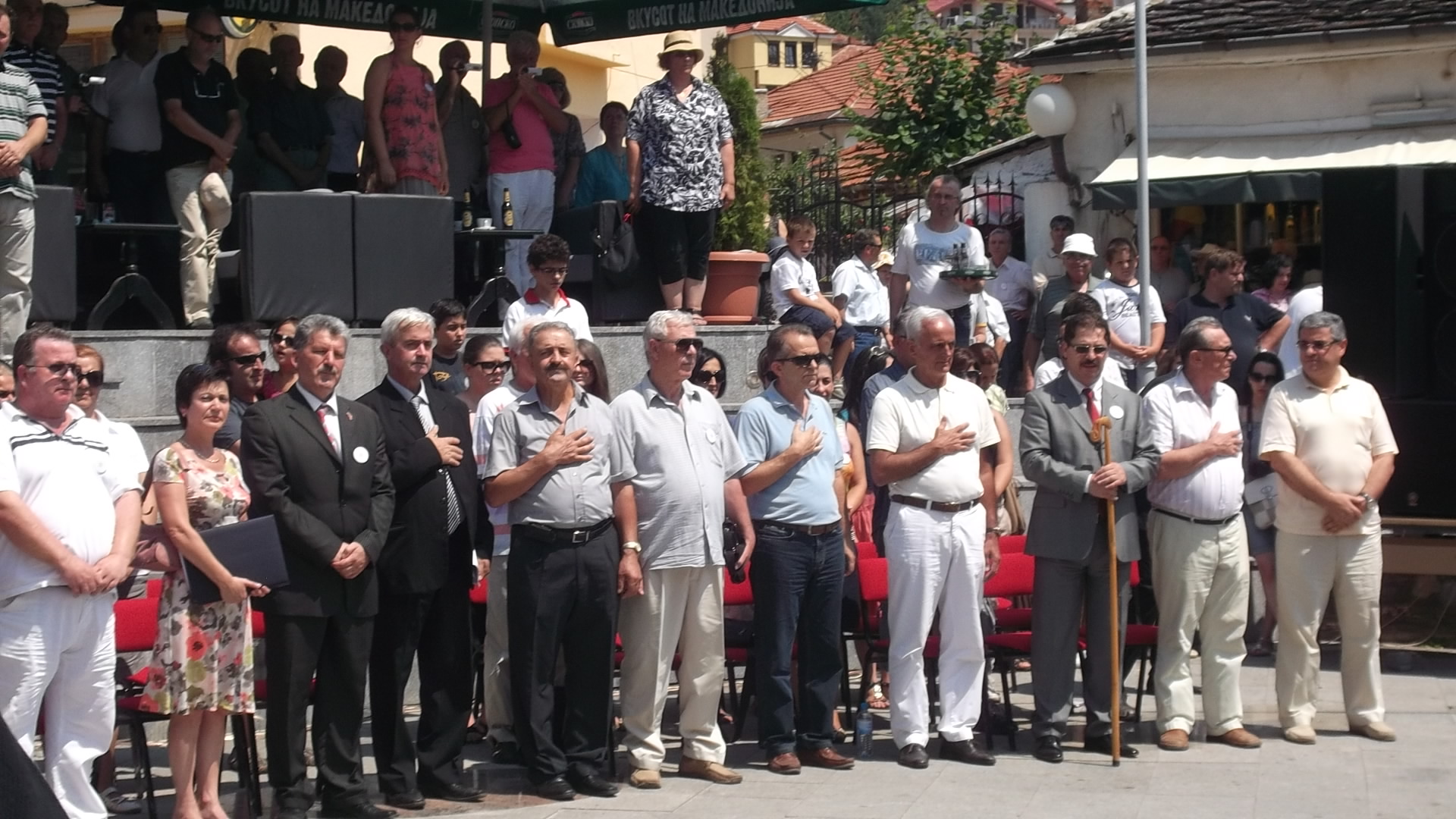
The mountain town Krushevo (Crushuva) was founded at the end of 18th century by the Makedon-Armâns who had left the burned places of Moschopolis in search of a similar place in order to establish “a new Moschopolis”, after this was burned down in 1769. The towm of Moschopolis in Albania is considered the birthplace of the Armân Enlightenment.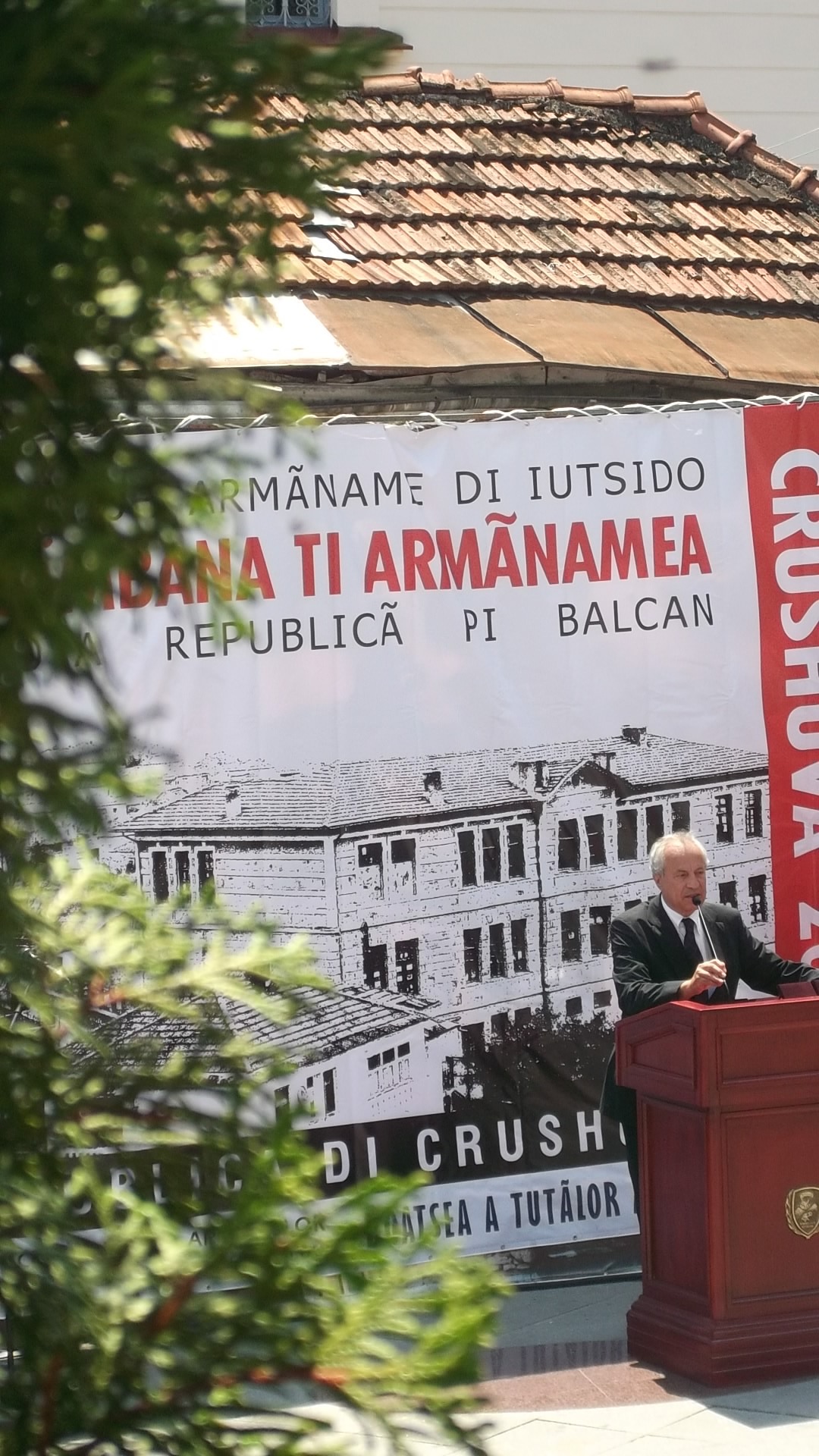
On the 5th of August 2012, Makedon-Armân communities from Albania, Romania, Bulgaria, Republic of Macedonia, Greece, Serbia, United States of America, France, and Germany gathered in Krushevo to celebrate the historical moment from 1903. The event brought together thousand of citizens of Makedon-Armân origins from the aforementioned states, and was accompanied by artistic performances that included music, dances and art shows. It also celebrated the traditions and history of an important regional community which has remarkably contributed to the regional and European culture over the years. In addition, it was both an occasion to highlight the beauty of music, culture and traditions and a deep reflection on the historical fate of Makedon-Armân people.
The Makedon-Armâns, known among themselves as “Armânji” or “Makedon-Armânji”, and among others as “Vlachs”, “Macedo-Aromanians” or “Makedo-Vlachs” are one of the oldest European peoples with deep roots in Ancient Macedonia.
Their traditional lifestyle was completely disrupted by the political changes in the Balkans at the beginning of the 20th century, after the Second Balkan War and the Peace Treaty of Bucharest (1913), when their territory, Macedonia was devided among four different states (Greece, Bulgaria, Serbia and Albania) and the borders were made permanent.
The cultural event began on Saturday, the 4th of August, in the afternoon, when some symposiums were held with the topic: “Place and role of Armân (Makedon-Armân) people in the historical event from Krushevo 1903 and in the establishment of national states in the Balkan region”. The second day of this event began in the morning with a Solemn Mass in Makedon-Armân language which took place at “Ayiu Yiani” Church, Krushevo. The church was built by Makedon-Armâns, between 1897 and 1903, the year of historical significance for Krushevo.
Two commemorative plaques were placed by the organizing committee of this event. One was placed at the Armân Church „Ayiu Yiani”, and the other one at the Monument of Pitu Guli , Armân hero from 1903. Makedon-Armân music performed by Armân singers from Balkans, was also part of the programme.
Important guests and many European institutions and organisations, Balkan countries governments were also invited to this Armân event – Krushevo 2012.
Regarding the critical situation of the Armân (Makedon-Armân) language and culture and taking into account their serious risk of extinction, the Council of Makedon-Armâns adopted the “Resolution Krushevo-2012”, requesting all Balkan states where Armâns live (Albania, Greece, Romania, Republic of Macedonia, Serbia and Bulgaria) to prevent such a cultural loss for Europe, to support their language in the fields of education, religion and the media. All participants agreed with the content of this Resolution*.
Concerned with issues regarding the education of the Makedon-Armân people living in the Balkans in their mother tongue, the Makedon-Armân Council has the duty to support the requests of the Makedon-Armân communities which are members of this council and to assure coordination, collaboration and fulfillment of all initiatives contributing to the preservation and promotion of the Armân language, traditions and cultural values.
*Resolution Krushevo 2012
THE GREAT ARMÂNS ASSEMBLY
August 5th 2012, Krushevo / Republic of Macedonia
We,
The Armâns / Makedon-Armâns from all Balkan states where we live, taking part at the Great Armân Assembly held in Krushevo , Republic of Macedonia, town established by our forefathers, to celebrate the historical moment of 1903,
Taking into account that the Armâns / Makedon-Armâns – one of the oldest European people, autochthons in the Balkans, have always been convinced that all people they have been living together with for centuries have to have the same rights, regardless of the differences in language, political or religious beliefs,
Taking into consideration that the Armâns / Makedon-Armâns – living among other old European people autochtons in Balkans – with their common conscience for culture, language, traditions and faith which gives them the will to assert that they are part of the same people, are an example for coexistence with other people,
Taking into consideration that the Armâns / Makedon-Armâns are entirely entitled to enjoy all the rights granted by the European and international norms like: The European Convention for Human Rights (1950), The ONU Pact for the civil and political rights (1966), The Frame-work Convention for the protection of national minorities (1994), The European Charter for the Regional or Minority Languages (1992), The Universal Declaration of Human Rights (1948), The Declaration on the rights of persons belonging to national or ethnic, religious and linguistic minorities (1992)
For all these reasons, The Council of Makedon-Armâns, adopts the herein
RESOLUTION
- The Council of Makedon-Armâns requests the decisional and constitutional factors and all public autorities of all Balkan states where Armâns live (Albania, Greece, Roumania, Republic of Macedonia, Serbia and Bulgaria) to intervene in order to assure the protection of the Armân’s system of values and their ethnical, cultural, linguistic and religious identity;
- The Council of Makedon-Armâns requests all Balkan states where Armâns live to ensure the Armâns all the rights given to those regional people without “kin state” like the Armân people is;
- The Council of Makedon-Armâns requests the government of Republic of Macedonia to enable an open and democratic dialogue in order to reach a better cooperation between the Armân community and the government institutions concerned with projects and programmes regarding the maintenance and development of the culture, the language and traditions. The Republic of Macedonia is the only Balkan state where the Armâns are recognized by the constitution as a distinct people. Nevertheless, there still has to be done much more for the implementation of the Armân rights in order to ensure the development of their language and culture;
- The Council of Makedon-Armâns requests an open and democratic dialogue with all the Balkan states‘ governments where Armâns live in order to find solutions for the future of the Armân language and culture, like the study in schools of the Armân language and language use in mass-media and church;
- The Council of Makedon-Armâns requests all Balkan states where Armâns live to provide in their Constitution a law for preserving the Armân language and culture as part of the national patrimony, following the example of France which did it for the Breton, Catalan, and Provençal cultures.
All these requests aim to preserve the Armân people with their distinct language and culture. They do not intend to depict the Armâns as an element of destibilization, but rather as one of integration and stabilization, as it has always been.
The present Resolution has been passed today, August 5th 2012, within the Great Armâns Assembly, on Krushevo.
August 5th 2012, Krushevo / Republic of Macedonia
Adunarea Armânjiloru (Makedon-Armânjiloru), Crushuva / R. Makidunia
tu 5 -li di Agustu 2012, Crushuva / R. Makidunia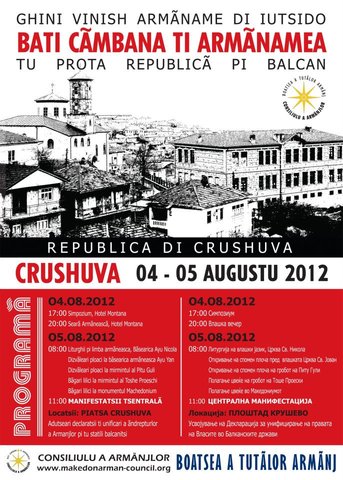 Kiro di dauâ dzâli, tu 4-li sh 5-li di Agustu 2012, tu câsâbălu armânescu Crushuva ditu Ripublica Makidunia – câsâbă thimiljiusitu aoa sh-cama di daua suti di anji di strâpâpânjlji Armânjiloru cari tu bitisita a etâljei 18, dupu tsi fu apreasâ Muscupolea, câftarâ sh-aflarâ aestu locu uidisitu – s-dirvâti Marea Andamusi a Armânjiloru di Iutsido
Aestâ andamusi di Crushuva, andreaptâ di Liga Armânjiloru ditu R. Makidunia, una di-atseali tsintsi sutsati / fari armâneshtsâ cari aoa sh-shapti anji thimiljiusirâ Consillu a Makedon-Armânjiloru, fu unu izvuru di dukeari safi armâneascâ, ashi cumu fu sh-prota Mari Andamusi a Armânjiloru di Iutsido di aoa sh-doi anji ditu loclu di isturii sh-culturâ armâneascâ ahândoasâ, Muscupolea / Arbinishii.

Sâmbâtâ, tu 4-li di Agustu, ahurhinda cu oara tsintsi dupu prândzu, Armânjilji tsi umplurâ sala di conferentsi di la hotellu “Montana” avurâ haraua s-ascultâ kiro di trei sihăts cumăts ditu isturia a câsâbălui Crushuva, di Ribilipsearea di la 1903, ti contributa Armânjiloru la thimiljiusearea a craturloru natsiunali ditu Balcanu, pârâstisiti di profesori universitari ditu craturli ditu Balcanu iu bâneadzâ Armânjlji. Tuti materialili tsi furâ pârâstisiti tu aestu simpozium va hibâ adunati tu unâ carti tsi va s-alânceascâ tu yinitorlu aprukeatu.
Zboarâ di ghinueari shi shcurti pârâstiseri trâ catandasea armâneascâ tu craturli ditu Balcanu iu bâneadzâ Armânjilji s-avdzârâ di la prezidentulu a comisiuniljei di organidzari, prezidentulu CMA, zboru di la cathi farâ armâneascâ ditu craturli ditu Balcanu, membri tu Consillu a Makedon-Armânjiloru. Fu dyivâsitâ sh-telegrama aprukeatâ di la pzezidentulu ali R. Makidunia, Dr. Georgi Ivanov, cata cumu sh-alti dimândări / aurâciunji aprukeati di la sutsati armâneshtsâ tsi nu puturâ s-ljia parti la aestâ andamusi.
Trâ Armânji tsi tu bana a loru cilâstâsirâ multu shi s-alumtarâ niacumtinatu trâ prublimatica armâneascâ, furâ dhurusiti plaketi di tinjii.
Hâbări cama multi di la aestâ andamusi furâ dimândati di massmediili armâneshtsâ tsi filmarâ aestu iventu. Ninti s-ahurheascâ pruyrama culturalâ fu aprukeatâ “Dimândarea di Crushuva” tsi poati s-hibâ dyivâsitâ ma-nghiosu.
Noi,
Armânjilji / Makedon-Armânjilji ditu tuti craturli iu bânămu, tsi himu adzâ la aestâ Andamusi Armâneascâ di Crushuva / R. Makidunia, câsâbă thimiljiusitu di strâpâpânjilji-a noshtsâ,
Luyursindalui câ Armânjilji / Makedon-Armânjilji – atselji di nai ma veclji tu aesti locuri ditu Balcanu – di daima furâ cândâsits câ tuti etniili cu cari bâneadzâ deadunu, fârâ s-hibâ loati tu isapi limba, buiaua politicâ icâ di pisti, s-aibâ idyili-ndrepturi,
Cara s-minduimu câ anamisa di vecljili populi evropeani, autohtonji tu Balcanu, Armânjilji / Makedon-Armânjilji – cu a loru sinidhisi ti cultura, limba, adetsli sh-pistea tsi lâ da vrearea sâ s-aspunâ tu lumi câ facu parti ditu idyiulu populu – suntu unâ paradhiymâ di banâ deadunu cu alanti populi,
Mutrindalui tuti atseali nomuri evropeani sh- internatsiunali – Conventsiunea Evropeanâ ti Ndrepturli a Uomlui (1950), Conventsiunea ONU andicra di Ndrepturli Tsivili sh-Polititsi (1966), Conventsiunea-Cadru trâ Avigljarea a Minoritătsloru Natsiunali (1994), Carta Evropeanâ a Limbilor Reghiunali icâ Minoritari (1992) – tsi furâ aprukeati maxus ta sâ aveaglji atseali populi fuvirsiti cari s-aflâ tu idyea catandasi tu cari s-aflâ sh-popullu Armân,
Ti tuti aesti itii, Consillu a Makedon-Armânjiloru apufuseashti aestâ
DIMÂNDARI
- Consillu Makedon-Armânjiloru caftâ la tuti craturli ditu Balcanu, iu bâneadzâ Armânjilji (Arbinishia, Gârtsia, Rumânia, Ripublica Makidunia, Sârbia, Vâryâria), ca tuti institutsiunli tsi au borgi tu dumenea ti ndrepturli a uomlui s-cilâstiseascâ trâ avigljearea a yishteriloru shi a identitatiljei etnicâ, culturalâ, lingvisticâ shi di pisti a Armânjiloru.
- Consillu Makedon-Armânjiloru caftâ la tuti craturli ditu Balcanu, iu bâneadzâ Armânjilji, s-asiyuripseascâ ndrepturli tsi lâ si pricadu Armânjiloru ca populu reghionalu, acshi cumu u spunu nomurli evropeani sh-internatsiunali trâ populi fârâ „kin state”.
- Consillu Makedon-Armânjiloru caftâ la guvernulu ditu Ripublica Makidunia – singurlu cratu ditu Balcanu iu Armânjilji suntu pricânâscuts tu Cunstitutsiuni, ama tu factu lipseashti s-da nica ma mări eforturi ta s-implementeadzâ ndrepturli cari lâ suntu garantati tu Constitutsiuni sh-cari dealihea s-lâ asiyurpseascâ developarea a limbâljei sh-a culturâljei a loru – unu dialogu dishchljisu trâ unâ cama bunâ cooperari / lucru deadunu anamisa di Armânami sh-institutsiunli ditu aestu cratu tsi au borgea s-andrupascâ popullu Armân pritu proyrami minduiti deadunu.
- Consillu Makedon-Armânjiloru caftâ unu dialogu dishcljisu, dimucraticu, cu tuti guvernili a craturiloru balcanitsi, iu bâneadzâ Armânjilji, tra sâ s-aflâ căljiurli trâ yinitorlu a limbâljei sh-a culturâljei armâneascâ, va s-dzâcâ bâgarea a limbâljei tu sculii, mass-media shi bâsearicâ.
- Consillu Makedon-Armânjiloru caftâ la tuti guvernili ditu Balcanu, iu bâneadzâ Armânjilji, s-aproaki tu Constitutsiuni unu nomu cari s-aveaglji cultura sh-limba armâneascâ ca parti di patrimonlu natsiunalu a cratlui, acshi cumu s-adră tu Frântsii cu yishtearea culturalâ a Bretonjiloru, Provensaliloru, Catalanjiloru etc.
Tuti aesti câftări au tu scupo s-nu kearâ Armânjlji ca populu ahoryea, populu cu a lui culturâ avutâ, limbâ sh-adets shi s-nu hibâ factoru di destabilidzari, ma s-hibâ factoru di integrari shi stabilidzari, ashi cum eara sh-pânâ tora.
Dimândari apufusitâ adzâ, 5-li di Agustu 2012, Crushuva / R. Makidunia, cu furnjia ali Andamusea Armâneascâ.
tu 5-li di Agustu 2012 / Crushuva, R. Makidunia
International Conference : Understanding Resilience and Shift in Regional & Minority Languages
06-08 April 2011, Leeuwarden / NetherlandsThis second international conference organised jointly by the Mercator European Research Centre on Multilingualism and Language Learning of the Fryske Akademy (The Netherlands) and the SOAS-UCL Centre for Excellence in Teaching and Learning „Languages of the Wider World“ (LWW CETL) (UK) took place from 6-8 April 2011 in the charming city of Leeuwarden, the capital of the bilingual province Fryslân (Netherlands).
Using mother tongue and learning a second and third language is a formal right for all people, a right which often is absent and its use in practice is often less well guaranteed and less developed than should be the case, especially for speakers of smaller or lesser used languages variously labelled as „regional“, „minority“, „community“, „heritage“ languages, etc. The conference focused on theoretical and empirical work in research, teaching and learning of such languages worldwide. Click here for the conference programme.
Abstracts of all presentations could be seen here.
The Macedonarmân Council accredited three representatives to participate at this Conference with the theme “Bilingualism, a new stage in the construction of the European identity – the case of Macedonarmâns„, presented by Nicolas Caracota, the general secretary of Macedonarmân Council.
For more details, see the section „Co-operation„
The Great Assembly of Armâns (Macedonarmâns) in Moschopolis (Voskopoje), Albania
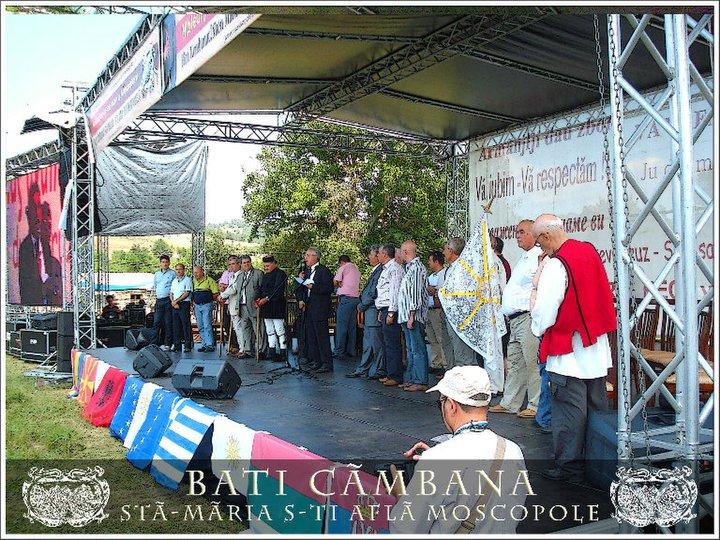
15 th August 2010, Moschopolis / Korce District / AlbaniaOn 15th of August 2010, Armân Communities in Albania, Romania, Bulgaria, Republic of Macedonia, Greece, Serbia, United States of America, Australia, Canada, France, and Germany gathered in Voskopoje, Korçë district / Albania, to celebrate the feast of Virgin Mary. This secular feast, honored by people in general and by Armâns (known also as Vlachs, Macedo-Vlachs, Makedonarmâns) in particular and which has brought together over ten thousand of citizens of Armân origins, from the aforementioned states, has been accompanied by artistic performance that included music, dances and art shows.
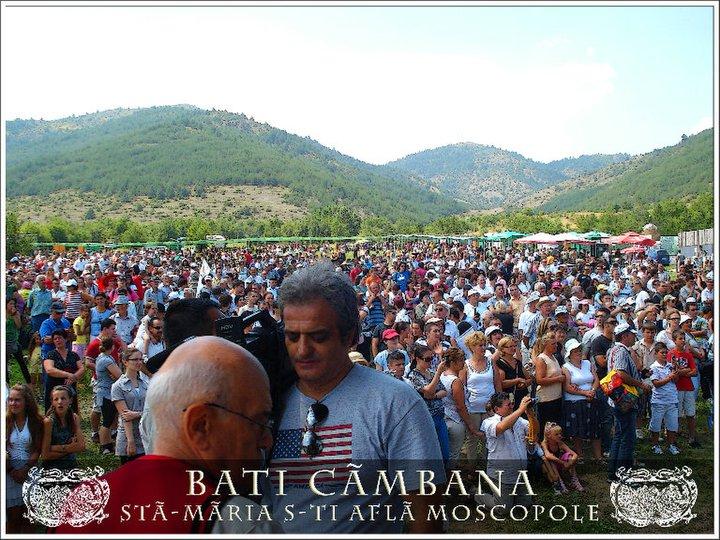
This event was organized by the Council of Armâns / Macedonarmâns. Moschopolis (Voskopoje) is the seat of the council, a place of symbolic value for this people with a unitary language, and whose traditions have deep roots in the ancient Macedonian heritage.
This event was organized to celebrate the traditions and history of an important regional community which has contributed remarkably to the regional and European culture and it did not represent only an occasion for highlighting the beauty of music, culture and traditions, was also a deep reflection on the historical fate of Armân people. The Armâns (Macedonarmâns), known among themselves as “Armân” or “Makedonarmân” , and among others as “Vlachs”, “Macedo-Aromanian” or “Macedo-Vlachs” are one of the oldest European peoples.
Moschopolis was the most important center of the Balkans in the 18th century, being the second city of the Balkans not only in population but also in prosperity, surpassed only by Istanbul at that time.
Moschopolis was the birthplace of the Armân Enlightenment. Names of learned Armân people such as Th. Anastasie Cavallioti, Daniil of Moschopolis, Constantin Ucuta, George Constantin Roja, Mihail G. Boiagi, N. Ioanovici, Dimitri Nicola Darvari, Constantin Emanoil Ghica of Djanfalva, Ioan Nicolidi of Pindu, who left books of major interest for philosophy, history, and science, are linked with the Cultural Movement of Moschopolis. Much has been written about the Cultural Movement of Moschopolis(18th century) but, unfortunately, no in-depth new research has been done on this European Balkan cultural phenomenon so far.
More interestingly, it is fascinating to see in this movement an initial start of the development of the European spirit in the Balkans. Just as Byzantium was not only Greek, although Greek was the language of writing, likewise, the cultural movement of Moschopolis could not bear witness to only one culture. Moschopolis gave birth to a multicultural movement. Macedonarmân, Greek, Albanian, and Slavic cultures lived together here .
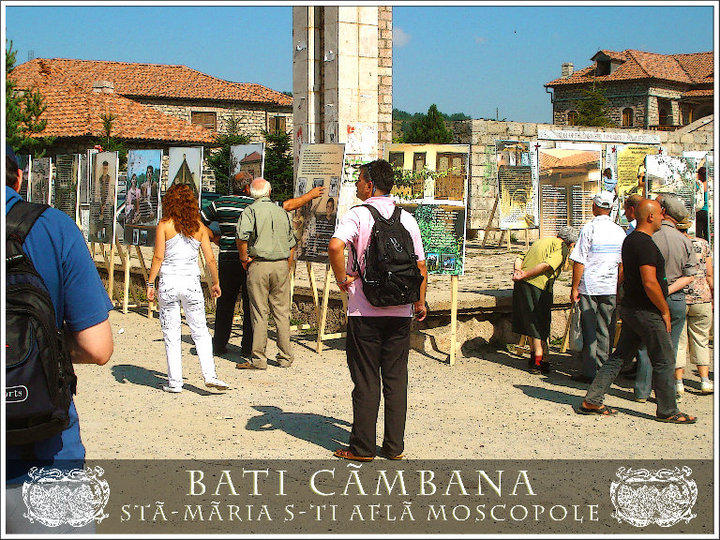
The feast began, on Sunday in the morning, with a Solemn Mass which took place at Virgin Mary Church – Moschopolis, and continued with songs and dances of Armân communities from allover Balkans. The programme of the Moschopolis event 2010 started some days before, on 12th of August, when some symposiums were held with themes: „Moskopole – its importance from the identity perspective of young Armâns and its place in the Balkans”, „Christian spirituality in the Balkans and its place in the developing of Moskopole’s culture”, „The current situation of regional people in Europe, and most precisely in the Balkans. Study on Armân people”. Armân music performed by Armân singers from Balkans, was also included in programme. Important guests and many European institutions and organisations, Balkan countries governments were also invited to this Armân event – Moschopolis 2010.
Taking into account the critical situation of the Armân(Macedonarmân) language and culture, which have been present in the Balkans for more than 2000 years, but face today a serious risk of extinction, the Council of Armâns / Macedonarmâns has prepared for this Assembly the “Resolution Moschopolis-2010”, adopted by all those over ten thousand participants. This Resolution requests to all the Balkans States where Armâns are living (Albania, Greece, Romania, Republic of Macedonia, Serbia and Bulgaria) to prevent such a cultural loss for Europa, to support their language in the fields of education, religion and the media. All participants agreed with the content of this Resolution*.
The engagement of the Armân (Macedonarmân) Council in issues concerning the education of the Macedonarmân people, in all Balkan countries where they live in, also in issues concerning the acsses to education in their own language, this engagement means in the same time an initiative on Language and Culture Diversity which starts from the premise that language diversity is the most important component of the cultural diversity.
* The Resolution „Moschopolis 2010“
THE GREAT ARMÂNS ASSEMBLY
August 15th 2010, Moschopolis / Voskopoje, Albania
We,
The Armâns from all the Balkans state where we are living, taking part into the Great Armân Assembly held on the St. Marry Day 2010 to celebrate this special and important Christian day and in the same time, our return to this symbolic place founded by our forefathers,
Taking into account that within the old European nations, autochthons/native in Balkans, the Armâns represent an example of historical continuity and a pattern of coexistence with the other nations,
Being convinced that nowadays, only we the Armâns, can tell the entire world who and what we are and that we have the great responsibility for saving our civilization,
Being aware of the fact that the Armâns have, for the first time in their modern history, the chance to express their real identity,
Taking into consideration that the Armâns are entirely entitled to enjoy all the rights granded by the European and international norms like: The European Convention for Human Rights (1950), The ONU Pact for the civil and political rights (1966), The Frame-work Convention for the protection of national minorities (1994), The European Charter for the Regional or Minority Languages (1992), The Universal Declaration of Human Rights (1948), The Declaration on the rights of persons belonging to national or ethnic, religious and linguistic minorities (1992)
For all these reasons, The Council of Armâns, adopts the herein
RESOLUTION
- The Council of Armâns requests to all the Balkans states where Armans are living (Albania, Greece, Roumania, Republic of Macedonia, Serbia and Bulgaria) that the decisional and constitutional factors and the public autorities with competences in the human rights area to intervene in order to assure the respect, the protection and the assertion of the Armân’s system of values and their ethnical, cultural, linguistic and religious identity;
- The Council of Armâns requests the Armân’s recognitions as a regional People, autochthon in Balkans;
- The Council of Armâns requests to all the Balkans states where Armâns are living to take a decision in accordance with the european and international standards that guarant the rights fitting to the Armâns as a regional people;
- The Council of Armâns requests an open and democratic dialogue with all the Balkans state’s guvernments in order to find out solutions for the future of the Armân language and culture, like the study in schools of the Armân language and language use in mass-media and church.
The present Resolution has been passed today, August 15th 2010, within the Great Armâns Assembly, on Moschopolis.
August 15th 2010, Moschopolis, Albania
Adunarea Atsea Mari a Armânjiloru (Makedonarmânjiloru), Muscopuli (Voskopoje), Arbinishii
tu 15 -li di Agustu 2010, Muscopuli / Curceaua, ArbinishiiPira apreasâ aua sh-doi anji di Costa Canacheu sh-purtatâ pritu Balcanu ta s-dimândâ Adunarea Atsea Mari a Armânjiloru di Iutsido, tu dzuua di Stâ-Mârii 2010, Muscopuli, adusi njilji sh-njilji di-Armânji nu mashi ditu craturli iu elji bâneadzâ, locurli a loru di daima, Makidunia Anticâ, ama sh-ditu alti stati ditu Evropa, America, Canada, Australii.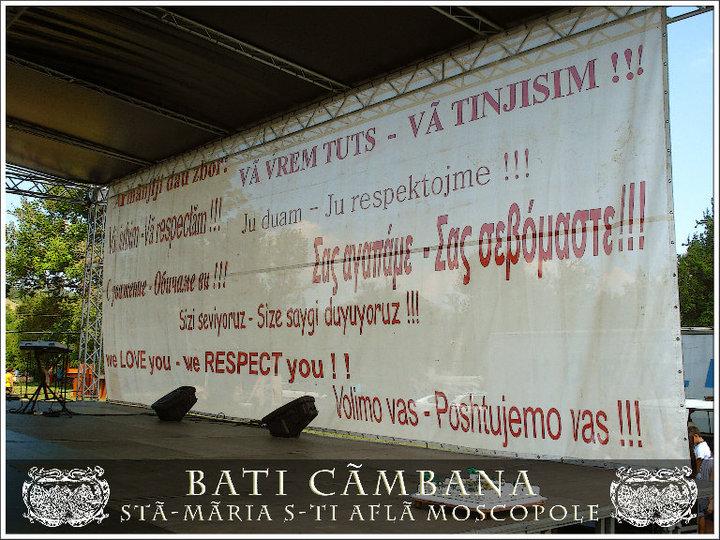 Aesta mari andamusi fu andreaptâ di Consillu Armânjiloru / Makedonarmânjiloru, hărgiurli furâ anvâliti di sutsatili armâneshtsâ cari aua sh-tsintsi anji bâgarâ thimeljlu alishtei organizatsiuni internatsiunalâ nonguvernamentalâ, unâ institutsiuni armâneascâ tsi ari borgea shi scupolu ta s-andrupascâ câftărli a Farilor Armâneshtsâ ditu cathi cratu ditu Balcanu cari au tu lucru vigljearea sh-diveloparea a limbâljei, a adetsloru sh-a ntreagâljei yishteari culturalâ armâneascâ tu tuti locurli iu suntu bânâtori.
Trâ exudli tsi s-featsirâ andrupârâ sh-Armânji cu vreari sh-dukeari trâ sinferlu armânescu.
Andamusea di Muscopuli, iu vinirâ Armânji ditu tuti părtsâli di lumi ta sâ s-cânoascâ, fu unâ furnjii ca Armânjilji sâ s-aspunâ ashi cumu suntu tu locurli iu bâneadzâ, fu unâ furnjii ca Armânjilji sâ spunâ a lumiljei câ nu kirurâ sh-câ nu voru ta s-kearâ, fu unâ furnjii sâ spunâ a lumiljei unâ parti di cultura sh-isturia armâneascâ di ma ninti sh-di adzâ.
Consillu Armânjiloru / Makedonarmânjiloru mindui s-andreagâ Muscopuli aestâ andamusi a Armânjiloru, trâ prota oarâ dupu tsi isturia lj-ampârtsâ aua sh-vârâ sutâ di anji, trâ itia câ aestu locu easti trâ noi, Armânjlji / Makedonarmânjilji, unu locu simbolicu trâ Minarea Culturalâ Armâneascâ di aua sh-cama di dauâ suti tsindzăts di anji, unu locu mplinu nu mashi di toarili a tricutlui ama sh-di seamnili a yinitorlui. S-andreapsi aestâ andamusi Muscopuli trâ itia câ tu aestu locu anyie trâ prota oarâ tu Balcanu unu spiritu ahoryea, putemu s-dzâtsemu evropeanu, ashi cumu s-caftâ adzâ tu Evropa nauâ.
Minduindalui sâ-lj si da alushtuiu iventu unâ simasii cama ahândoasâ, pareili di tiniri tsi andrupârâ multu andridzerli trâ aestâ andamusi, organidzarâ trâ dizvârtearea a pruyramâljei sh-trei simpoziumuri tu dzâlili di Gioi, Viniri sh-Sâmbâtâ cu themi ligati di isturia a câsâbălui Muscopuli sh-loclu a lui tu Balcanu, di spiritualitatea ortodoxâ tu Balcanu sh-loclu a ljei trâ acrishtearea a culturâljei muscupuleanâ. Simpoziomlu di Sâmbâtâ tsi avu ca themâ “Catastasea di tora a populiloru reghionali tu Evropâ sh-maxusu tu Balcanu, studiu trâ Armânji”, cumândâsitu di duruta armânâ Av. Chirana Darlaiani, s-hârsi di unâ mari partitsipantsâ, s-purtarâ multi cuvendzâ ligati di catastasea Armânjiloru di tora tu cathi cratu ditu Balcanu iu elji bâneadzâ.
Gioi dicsearâ fu andreaptâ la casa a pricljisitorlui Thoma Jidro di Curceaua unâ galerii di artâ cu lucrări di sclupturâ sh-zugrâpseri di artishtsâ Armânji, trâ cari multu andrupâmintu lu deadi cunuscutlu pricljisitoru armânu Mihali Tugearu, tsi ari agiutatâ multu sh-trâ andridzerli ali padea di Muscopuli, aclo iu Dumânicâ s-adunarâ njilji di Armânji di iutsido.
Dzuua di Dumânicâ, di Stâ-Mârii, avigljitoarea Armânamiljei, dzuuâ pisimâ aleaptâ maxusu trâ Adunarea Atsea Mari a Armânjiloru, ahurhi cu Liturghia tu bâsearica „Stâ-Mâria” di Muscopuli iu preftulu Thoma Samara tsânu Dyiavasea tu mushata limbâ armâneascâ. Dupu agiumta a uaspitsloru tu padea di Muscopuli, andreaptâ maxusu trâ aestu iventu, la sihatea 12:00, prezidentulu a Consillui Armânjiloru dishcljisi Adunarea Atsea Mari a Armânjiloru, dupu cuvenda a lui, zburârâ vitseprezdentsâlji ditu consilu tsi suntu sh-prezidentsâ a Fariloru membri tu Consillu Armânjiloru: Mita Papuli (R. Makidunia), Steryiu Samara (Rumânii), Arben Lena (Arbinishii), Nico Chiurkci (Vâryârii), Lila Cona (Sârbii), Iancu Perifan (Frântsii), sh Niculaki Caracota – grâmâticlu gheneralu a Consillui Armânjiloru.
Tinjisi aestâ andamusi parlamentarlu evropeanu, armânu ditu Rumânii, Gigi Becali, cu zborlu tsi l-u avu. Ditu Arbinishii, Ministerlu trâ Culturâ tinjisi andamusea armâneascâ di Muscopuli cu zborlu alu Nikola Lena.
Cu multâ harauâ fu aprukeatâ mintimena cuvendâ a prezidentului di la Sutsata Armânjiloru di Veria, Yioryi Prapa.
Tu bitisita a cuvendzâloru, Yiani Mantsu, prezidentu a Consillui Armânjiloru, pârâstâsi „Dimândarea – Muscopuli 2010”, apufusitâ tu Biroulu di Cumândâseari a Consillui Armânjiloru / Makedonarmânjiloru, dimândari / rezolutsiuni tsi fu aprukeatâ cu multâ harauâ di Armânjilji tsi vinirâ la andamusea di Muscopuli.
Ditu pruyrama artisticâ tsi s-dizvârti kiro di patru sihăts, cu sutsati di giucâtori sh-cântâtori ditu R. Makidunia, Rumânii, Arbinishii, prindi s-adutsemu aminti haraua tsi u-avurâ tuts ascultândalui mushatili cântitsi armâneshtsâ ali naima avdzâta cântâtoari ditu Arbinishii, armâna Eli Fara.
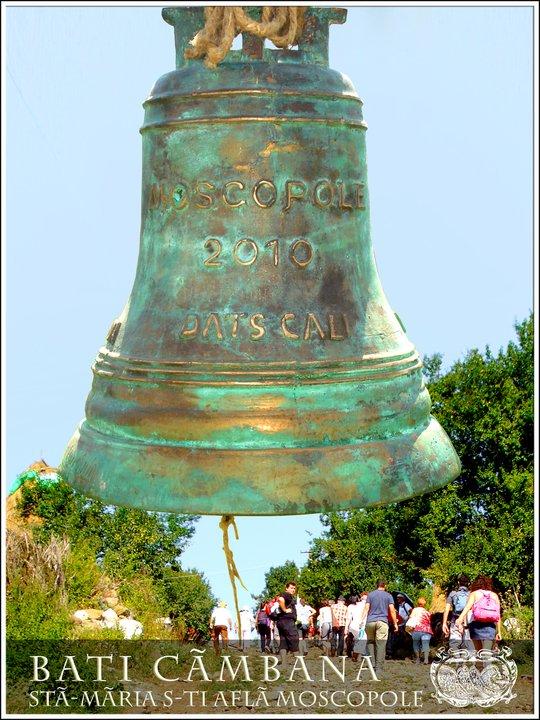
Adunarea di Muscopuli, fu prota Mari Adunari a Armânjiloru di iutsido. Vremu s-pistipsimu câ aestâ ahurhitâ va s-agiungâ s-hibâ unâ aradhâ tu yinitoru, sh-tu alti locuri armâneshtsâ iu s-nâ spunemu a populiloru, anamisa di cari bânămu, cu yishtearea a noastâ culturalâ tsi dzuuâ di dzuuâ vremu s-u acrishtemu.
Ti tuti andridzerli trâ aestâ Mari Andamusi di Muscopuli prindi, fârâ di altâ, s-hâristusimu prota a pareiloru di tiniri ditu craturli ditu Balcanu, cari kiro di unâ stâmânâ, cumândâsits di vrearea shi shtearea trâ ahtări lucri alu Costa Canacheu, managerlu andridzeriloru alishtei andamusi, lucrarâ dzuuâ sh-noapti ta s-adarâ ditu Muscopuli unâ hoarâ safi armâneascâ, andreaptâ ca tu unu pirmithu ditu cărtsâ, cu tutâ isturia a ljei, spusâ pritu caduri mări, arâdâpsiti ditu intratâ pânâ tu padea iu s-ari dizvârtitâ pruyrama andamusiljei.
Lucurlu tsi-lu featsirâ tinirlji Thanas Stamuli, Steryiu Stamuli, Nasi Calintsaru, Dana Costea, Laura Armeanu, George Zgura, Shtefan, Cati Custura, Cornelia Zaifu, Flori Tase, Dana Custura, Theo Nicolae, Nicole Tugearu, Mihali Caciandoni, Costin Damasharu, Giorgiana Tugearu, Nicu Vrana, Erica Tugearu, Costin Guci, Cristina Angiara, Nico Poci, Elton Ciaushi, Nico Kapurani, Zico Angiara, Custandin Tsatsa, Andoni Shcodrani, Custica Zguri, Vasili Zguri, Custica Poci, prindi s-lu alâvdămu shi s-lu tinjisimu (ljirtari, ma s-hibâ di agârshimu vârâ numâ).
La aestâ mari andamusi furâ câlisiti kivernisili a statiloru ditu Balcanu iu bâneadzâ Armânjilji, sh-multi alti institutsiuni evropeani, nvitsats evropeanji avdzâts, di iu aprukemu mushati zboarâ di hâristuseari sh-di lucru ambaru, zboarâ di pricunushteari ti lucurlu tsi-lu fatsi Consillu Armânjiloru/Makedonarmânjiloru.
Cu aestâ Andamusi a Armânjiloru di Iutsido, Armânjilji spusirâ câ suntu UNU POPULU, unâ mileti ahoryea, cu idyia limbâ, adets, culturâ, a s-hibâ câ isturia lj-ampârtsâ di vârnâ 100 di anji, fârâ sâ-lj ntreabâ.
Consillu Armânjiloru pitricu unu mesagiu di Vreari, Acâkiseari sh-di Dialogu câtâ tutâ Armânamea sh-câtâ tuti kivernisli a craturiloru iu bâneadzâ Armânjilji.
Vremu s-pistipsimu câ aestâ protâ Adunari Atsea Mari va dishteaptâ vrearea sh-dukearea trâ lucurlu armânescu, acâkisearea anamisa di-Armânji trâ sinferlu safi Armânescu!
Tora, ti Stâ-Mârii, 2010, Armânjilji s-dukirâ ca pi numtâ! Sh-dealihea, numtâ fu Muscopuli! Armâtusitâ ca-nveastâ, tu nalili stranji simbolitsi, Muscopuli sh-ashtiptă cuscârilji… Sh-cuscârilji vinirâ ditu tuti locurli-a Balcanlui sh-di ma alargu, ditu tutâ lumea.
Nu bânămu unu yisu Muscopuli! Aclo s-featsi ISTURII!
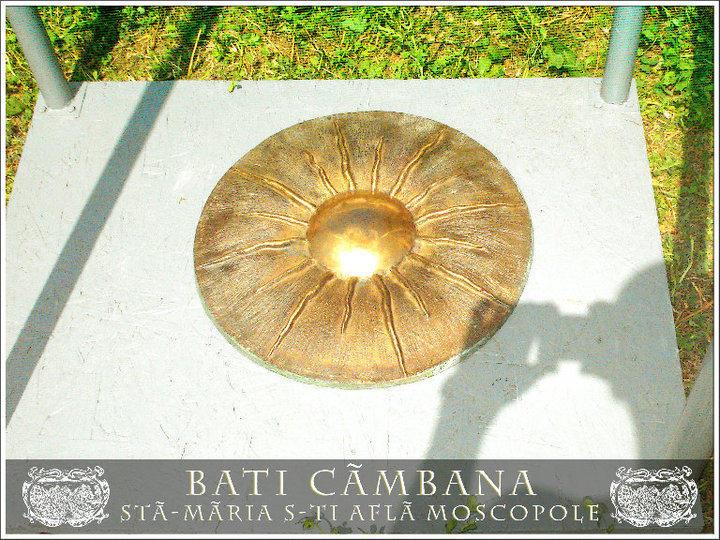
Consillu Armânjiloru / Makedonarmânjiloru nu avu scupo s-andreagâ unâ “gimbushi”, unu festivalu folcloricu – cumu s-fatsi di vârâ 25 di anji… Scupolu fu sâ scoalâ boatsi tu numa a Armânjiloru – populu fermentu, thimiljiusitoru, tu Balcanu, ama agârshitu, avinatu, aspâreatu, pimtu tu complexi psefti – tamamu tra sâ s-anvâleascâ toarâli averlui: Armânjilji mutarâ adârâminti culturali di mari simasii iutsido iu bânarâ sh-tricurâ, nu mashi trâ elji, ama trâ tuts…Atselji tsi furâ Muscopuli, tu dzuua pisimâ di Stâ-Mârii, dukirâ unu lucru: Turnarea Muscopuli fu Anchisearea câtâ yinitoru a Armânjiloru!
“Dimândarea” a CMA, aprucheatâ di njiljili di-Armânji adunats Muscopuli, zboarâli a uaspitsloru spusirâ limbidu câ, trâ prota oarâ, Armânjilji sâ spunu tu lumi mashi ca Armânji !.
*
* *
ADUNAREA ATSEA MARI A ARMÂNJILORU
15-li di Agustu 2010, MUSCOPULI
DIMÂNDARI
Noi,
Armânjilji ditu tuti craturli di iu bânămu, tsi himu vinits la Adunarea Atsea Mari di Muscopuli, dizvârtitâ tu dzuua di Stâ-Mârii, 2010, tra s-yiurtusimu unâ aleaptâ dzuuâ pisimâ sh-tu idyiulu kiro turnarea a noastâ tu aestu locu simbolicu, thimiljiusitu di strâpâpânjilji-a noshtsâ,
Ma s-luyursimu câ anamisa di vecljili populi evropeani, autohtonji tu Balcanu, Armânjilji suntu paradhiymâ di continuitati istoricâ sh-unâ urnechi di bânaticu deadunu cu alanti populi,
Cândâsits câ adzâ, mashi noi, Armânjilji, putemu sâ spunemu dinintea a lumiljei cari sh-tsi himu sh-câ purtămu unâ ahoryea fortumâ ti ascâparea a tsivilizatsiljei a noastâ,
Minduindalui câ Armânjilji au trâ prota oarâ tu isturia a loru modernâ, shansa tra sâ s-aspunâ a lumiljei cu identitatea a loru dealihea,
Avândalui tu videalâ câ Armânjiloru lâ si pricadi tra sâ s-hârseascâ di tuti ndrepturli siyurâpsiti di nomurli evropeani shi internatsiunali tsi va li tritsemu pi-aradâ: Conventsia Evropeanâ ti Ndrepturli a Omlui (1950); Cundrata ONU tu ligâturâ cu Ndrepturli Tsivili sh’Polititsi (1966); Cundrata-cadru trâ Avigljarea a Minoritâtsloru Natsiunali (1994); Carta Evropeanâ a Limbilor Reghionali icâ Minoritari (1992); Declaratsiunea Universalâ ti Ndrepturli a Omlui (1948); Declaratsiunea ONU tu ligâturâ cu Ndrepturli a inshiloru tsi tsânu di minoritătsli natsionali icâ etnitsi, di pisti sh’lingvistitsi (1992),
Ti tuti aesti itii, Consillu Armânjiloru apufuseashti aestâ
DIMÂNDARI
- Consillu Armânjiloru caftâ la tuti craturli ditu Balcanu, iu bâneadzâ Armânjilji (Arbinishia, Gârtsia, Rumânia, Ex Ripublica Iugoslavâ Makidunia, Sârbia, Vâryâria) ca factorilji detsizionali, constitutsionali shí autoritătsli publitsi tsi au borgi tu dumenea ti ndrepturli a omlui s-cilâstiseascâ tra s-asiyuripseascâ tinjisearea, avigljearea shi acrishtearea a yishterilor shi a identitatiljei etnicâ, culturalâ, lingvisticâ shi di pisti a Armânjiloru.
- Consillu Armânjiloru caftâ pricânushtearea a Armânjiloru ca populu reghionalu tsi easti autohtonu tu Balcanu.
- Consillu Armânjiloru caftâ la tuti craturli ditu Balcanu, iu bâneadzâ Armânjilji, s-ljia unâ apofasi tu noima a nomuriloru evropeani sh-internatsiunali cari siyurâpsescu ndrepturli tsi lâ si pricadu Armânjiloru ca populu reghionalu.
- Consillu Armânjiloru caftâ unu dialogu dishcljisu, dimucraticu, cu tuti guvernili a craturiloru balcanitsi, iu bâneadzâ Armânjilji, tra sâ s-aflâ căljiurli trâ yinitorlu a limbâljei sh-a culturâljei armâneascâ, va s-dzâcâ bâgarea a limbâljei tu sculii, mass-media shi bâsearicâ.
Dimândarea apufusitâ adzâ, 15-li di Agustu 2010, Muscopuli, cu furnjia Adunariljei Atsea Mari a Armânjiloru.
tu 15-li di Agustu 2010 / Muscopuli, Arbinishii
The Conference of Armân ( Macedonarmân ) Council
12 th December 2009, Korce / AlbaniaThe Council of Armâns ( Macedonarmâns ) organized the first session of the Conference of the Council of Armâns ( Macedonarmâns ) which took place on 12 December 2009 in Korce / Albania.
The Armâns ( Macedonarmâns ), one of the oldest European peoples, aware of their history, national unity and common historical motherland, represented by several associations based in the countries they live in as part of their historical motherland, such as Albania, Republic of Macedonia (FYROM) and Bulgaria, as well as by associations living in Diaspora, such as Romania and other countries, have decided to establish The Council of the Armâns, which was registered, in July 2008, as a legal entity with the Department of Justice in Tirana, Albania. The seat of the Council was established at Moscopole / Albania, a place of symbolic value for this people with a unitary language, and whose traditions have deep roots in the ancient Macedonian heritage.
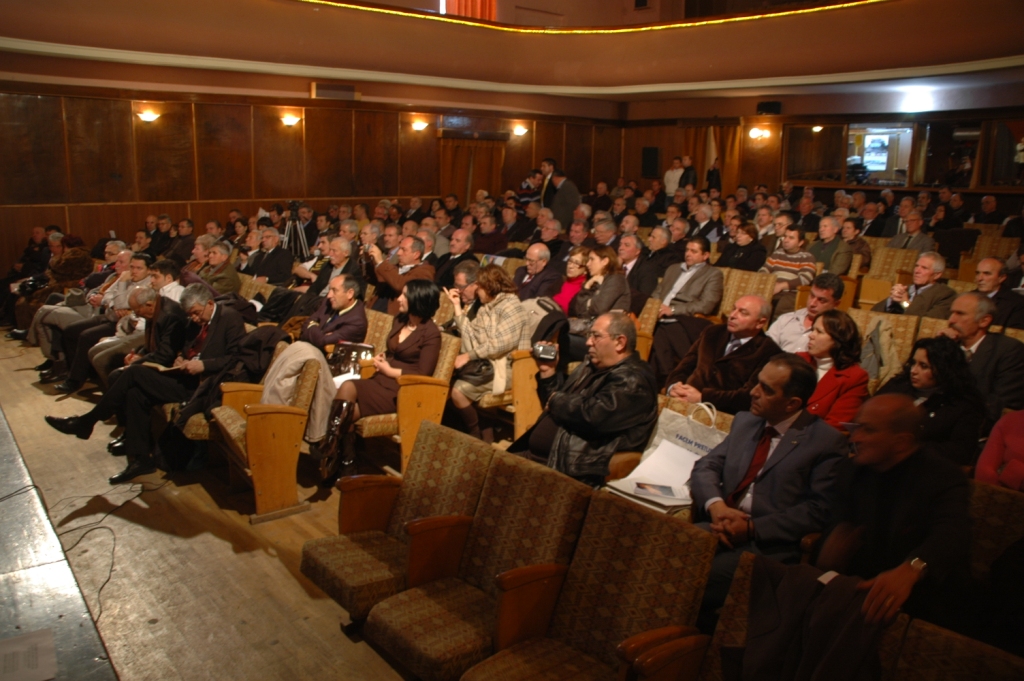 The forum of this inaugural session provided a platform for promoting dialogue and cooperation among all representative Armân associations from Balkan countries on issues pertaining to preserving, developing and promoting the Armân language, culture and traditions, as well as the whole Armân specific spirit in every state where Armâns live and where they associate themselves in representative organizations.
The participants at this conference, over 25 Armân associations, have exchanged points of views on ways to establish a better cooperation not only between Armâns and institutions with which they are in contact but also between the Armâns living in the countries of the Balkan Peninsula in order to ensure a strong cohesion between the Armân communities in all the countries where they live.
At this inaugural session of the Conference of Armân ( Macedonarmân ) Council were invited all representative Armân associations from Balkan countries and diaspora, without taking into account the difference of opinion or differences in point of view in matters concerning the true origin of this old European people. Is also notebly the participation of „Convivenza“, the International Center for Minorities who, two years ago, in collaboration with FUEN, organized a seminar on cross-border cooperation of the Armâns ( Macedonarmâns ), in Disentis / Switzerland.
Notebly for this Macedonarmân „event”, is also the participation of the “Panhellenic Federation of Cultural Associations of Armâns / Vlachs” and others Armân associations from Greece who expressed their agreement concerning the preservation of the Armân(Macedonarmân ) language by facility of promovating of Armân language in educational institutions.
All participants have expressed the duty to defend and to develop the Armân cultural patrimony, and to transmit it to the future generations of Armâns. They also agreed with the most important matter that unite all Armân associations from overall : the responsibility to make efforts in every community from the states where they live, for preserving, developing and promoting the Armân ( Macedonarmân ) language.
The Conference ended with two cultural events in Korce / Albania and Veria / Greece : an Armân theatre group from Bucharest, presented Aristophanes‘ comedy “Clouds”, in Armân ( Macedonarmân) language, adapted and stage-managed by the Armân regisseur Toma Enache. It was the second time such cultural event took place in Albania but for the first time in Greece, where about 500 spectators enjoyed this historical moment. This was enabled due to the efforts of the “Armân Association from Veria” and the support of the municipality of Veria to organize this cultural event.
This first Conference of the Armân ( Macedonarmân ) Council could also be considered a preparing session for the First International Congress the council intends to organize it next year in Tirana / Albania.
Conferintsa Consillui Armânjiloru ( Makedonarmânjiloru )
12-li di Andreu, Curceaua, ArbinishieSâmbâtâ, tu 12-li di Andreu, estanu, s-dizvârti Curceaua / Arbinishie, Conferintsa Consillui Armânjiloru (Makedonarmânjiloru), prota conferintsâ andreaptâ di Consillu Armânjiloru, consilu tsi s-amintă aoa sh-patru anji, tu meslu Sumedru 2005, cu scamnulu Moscopolea sh-biroulu di lucru Curceaua.
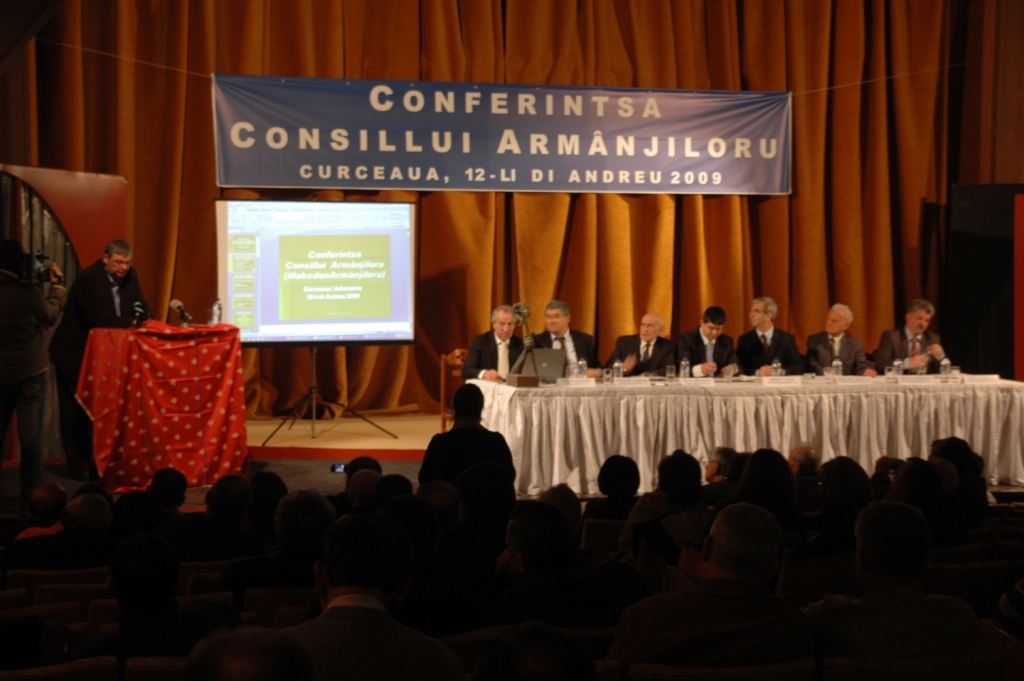 La aestâ andamusi a Armânamiljei di iutsido – iu furâ acljimati tuti sutsatili, nu mashi atseali cari chiola suntu membri tu consilu, fârâ s-hibâ loatâ tu isapi dhiafuraua tu mindueari andicra di problematica armâneascâ – loarâ parti cama di tsintsisprăyinyits di sutsati armâneshtsâ ditu Arbinishie, Gârtsie, R. Makidunia, Românie, Sârbie, Vâryârie, sutsati ditu diaspora ditu ascâpitatâ, parei di redactsie (rivisti, dzuari, radio-tv) ditu mass-media armâneascâ di iutsido.
Dupu zborlu di dishcljideari a prezidentlui, s-deadi shteari di cumu s-bâgă thimeljilu la Consillu Armânjiloru (Makedonarmânjiloru), cari-lj suntu scupadzlji, tsi lucru featsi pânâ tora, s-alâxirâ minduieri cu-atseali sutsati cari nica nu suntu membri, trâ tsi căljiuri s-acâtsămu tuts deadunu tra s-amintămu andrepturli tsi nâ si cadu ca populu di nai ma vecljili tu Balcanu.
Tu zborlu tsi lu-avu, cathi vitseprezidentu di la sutsatili membri tu consilu deadi shteari ti catastasea armânjiloru ditu cathi cratu. Andicra di statutu, s-azburâ sh-di turlia cumu s-hibâ aprukeati ca membri tu consilu, sutsatili tsi va-sh aspunâ vrearea ta s-intrâ tu consilu cu harea di membru mplinu icâ cu harea di membru di andrupâmintu.
Di la aestâ protâ conferintsâ a Consillui Armânjiloru, prindi s-ascutemu tu videalâ unitatea tu mindueari mutrindalui copuslu tsi tuts deadunu lipseashti s-lu fâtsemu di-aoa shi-nclo ta s-tsânemu nica tu banâ “hlambura a farâljei“ – limba armâneascâ: “S-avinămu pâmoara laie / Tsi-anvâleashti ca nivaiu / Patrida tsi n-ari-armasâ / Mashi a nostu dultsi graiu”
* *
*
Theatru Armânescu Curceaua – Veria
 Cu furnjia conferintsâljei, Consillu Armânjiloru deadunu cu Uniunea Armânjiloru MANDRA ditu Arbinishie sh-cu Sutsata Armânjiloru di Veria andreapsirâ dauâ reprezentatsiuni di theatru cu piesa “Secta a Muljeriloru”, dupu comedia alu Aristofan “Niorilji”, tu reghia alu Toma Enache, tsi s-giucă tu theatrulu di Curceaua, Dumânicâ 13-li di Andreu sh-Luni, 14-li di Andreu, tu theatrulu di Veria.
Aoa sh-unu anu, cându Curceaua sh Tirana, s-ari giucatâ piesa “Minciunoslu” alu Carlo Goldoni, tu idyia reghie, fu prota oarâ cându armânamea ditu Arbinishii avu haraua s-veadâ unu teatru armânescu. Tutu ashi, estanu, cându theatrulu tu dultsea limbâ armâneascâ fu uaspi la armânamea di Veria, armânjilji ditu aestâ mushatâ politii avurâ haraua s-bâneadzâ idyiulu yisu.
Aestâ ciudii putu sa s-facâ ti itia câ Sutsata Armânjiloru di Veria, deadunu cu dimarhia / primăria avurâ vrearea s-andreagâ aestu evenimentu culturalu cari poati s-hibâ luyursitu ca semnu di mindueari evropeanâ. Duchimu cu aestâ furnjie câ dimocratsia easti acasâ tu Gârtsie, ahâtu chiro câtu ari oaminji cari potu sh-voru s-u tinjiseascâ!
Hâristusimu ditu tutâ inima, a fratsloru di la Sutsata Armânjiloru di Veria ti vrearea tsi u-avurâ s-andreagâ aestu evenimentu culturalu, unâ harauâ tsi nu va u-agârsheascâ atselji cama di 400 di oaminji tsi umplurâ sala di theatru “Horos Tehnon”. Adyivâsits ma-nghiosu apridutsearea articullui tsi alânci tu efemeridha di Veria andicra di aestu evenimentu culturalu :
“ Aristofan….tu limba armâneascâ : Un spectacol interesantu andreptu di armânjlji di Bucureshti
Sutsata Armânjiloru di Veria adusi deadun armânji ama sh-altsâ oaminji ditu câsâbă, ta s-veadâ unâ altâ parti alu Aristofan…tu limba armâneascâ. Spectacollu spusi multu sinferu sh-fu multu ghini andreptu di armâjlji di Bucureshti. Prezidentul a Sutsatâljei Armânjiloru di Veria – domnulu Taki Yioryiu – dzâsi tu „Choros Technon“ (sala iu s-giucă piesa) câ spectacollu ari unâ mushuteatsâ ahoryea shi lâ hâristusi a teatrinjloru di Bucureshti câ apândâsirâ diunâoarâ la acljimarea sutsatâljei di Veria. Tutnâoarâ, prezidentulu dzâsi câ multsâ di teatrinji sh-au zâtsinjilii tu Epiru sh-tu Makidunii. Toma Enache – reghizorlu tsi andreapsi pânâ tora multi piesi di suctsesu, ditu cari ndauâ sh-pi armâneashti – sh-ari zârtsinjili Katerini shi Edessa. Elu aleapsi, interpretă un rolu shi cumândâsi piesa “Niorlji” alu Aristofan, tsânândalui mitlu orighinalu alishtei comedii – tsi fu anyrâpsitâ tu anlu 423 ninti di Hristo. Toma Enache alâxi mashi bitisita, tsi u andreapsi ashi turlii ta s-hibâ câtu cama uidisitâ cu bana multu materialistâ di adzâ.
Eroulu alu Aristofan – Strepsiades – avea multâ borgi ti itia a hiljlu-a lui – Fidipides – tsi-lj avea multu tu vreari caljlji (tu atselu chiro, caljlji eara ashi cum suntu adzâ amaxili atseali scumpi). Elu vrea s-ascapâ di borgi pritu arâderi shi-lj câfta agiutoru a sotslui a lui filozofu, Socrate, tsi avea unâ puteari ahoryea di cândâseari – alâxindalui nindriptatea tu ndriptati. Aristofan lu zuyrâpsi Socrate ca un dascalu, tsi-lj arâdea shi-lj pindzea tinirlji câtâ lucri psefti. Strepsiades, avdzâ anvitsâmintili alu Socrate, ma nu fu axi s-li acâchiseascâ. Tu atselu chiro, Socrate lucra cu niorlji, ideii tsi s-leagâ di transtsedentalu, filozofii shi metodologhii. Cara vidzu ashi, Strepsiades lu pitricu hilji-su Fidipides ta s-ljia anvitsâminti di la Socrate, cu nâdia câ aestu va li-acatsâ tu minti cama ayonjea shi va lu-agiutâ s-ascapâ di borgi. Fidipides acâchisi anvitsâmintili alu Socrate, ama s-adră un tiniru tsi nu tinjisea nitsi unâ axii traditsionalâ. Cara vidzu ashi, Strepsiades bagâ focu tu sculia alu Socrate. Pânâ tu aestu puntu, mitlu clasicu nu fu alâxitu. Tu piesa numâsitâ di Toma “Secta a muljeriloru” s-adusi un simbolismu safi feaminu shi unâ buljeauâ di pan-sexualismu (tsi va s-dzâcâ câ dauli sexi suntu isa) pritu gioclu a featiloru – niorlji. Aestâ luyurii easti unâ amprentâ reghizoralâ personalâ, una alâxeari a piesâljei orighinalâ. Un mari nvitsatu ditu isturia literaturâljei di greacâ veaclji – profesorlu Albin Lesky di la Universitatea di Viena – dzatsi ti niori: “ easti zborlu di un nău chiro, tsi shtii s-hârseascâ singuru, ahoryea di tsi easti ndreptu sh-eticu…”. Toma Enache s-dutsi ma alargu cu minduearea shi nâ pârâstâseashti unâ bitisitâ spectacularâ, tu cari ditu “tserlu” a stsenâljei cadu pâradz (dolari – simbolismu multu bun) fârâ numiru, pâradz cari teatrinjlji alagâ sâ-lj acatsâ. Pritu aesta sâ spusi multu ghini câtu multu-lu voru oaminjlji “dumidzălu” di adza – parălu. Cheardirea axiiloru dutsi câtâ sclayii totalâ , câtâ materialismu shi s-bitiseashti cu câdearea tu amârtii – a omlui ishishi cum sh-a pareiljei a lui. Toma ishishi, tu zborlu ditu soni, dzâtsi câ, “anda omlu sh-cheari pistea tu Dumnidză, atumtsea elu agiundzi s-hibâ un clownu”. Ti multsâ di noi atselji tsi earam tu salâ, fârâ s-cânushtemu limba armâneascâ, eara naturalu s-avemu shubei tu ahurhitâ tu-atsea tsi mutreashti putearea noastâ di acâchiseari a piesâljei shi curagilu a teatrinjloru. Ama, ditu prota minutâ, aestâ piesâ agiumsi tu inima a cafi unu insu ditu salâ – idyea sh-la atselji tsi nu zburăscu armâneashti. Aestâ fu unâ apurii (surprizâ) multu msheatâ.
Reghizorlu anâchisi s-comunicâ multu ghini cu tuts spectatorlji, pritu putearea datâ di turlia tu cari s-mina teatrinjlji. Piesa avu sh-proiectsii video, cu una esteticâ multu bunâ sh-cari adusirâ tu salâ turlii-turlii di sinhisilji (emotsii). Tutu ashi, sh- muzica (modernâ shi traditsionalâ) eara ghini sh-cu mintiminii aleaptâ, ti cathi momentu tsi s-pârâstâsi. Coregrafia eara multu ghini cumândâsitâ sh-uidusitâ cu improvizatsiuni. Tuts oaminjlji ditu salâ duchirâ câ suntu dinintea la una pârâstâseri multu ahoryia. Tu tsi mutreashti teatrinjlji, aeshtsa giucarâ piesa multu naturalu, s-uidisirâ multu ghini ca parei. Multu uidisitu giucarâ Toma Enache – tu rol di Socrate (ashi cum shi Aristofan s-videa tu aestu rol) -, Vasile Topa – tu rol di Strepsiades – shi Sorin Shaguna – tu rol di Fidipides (a s-hibâ câ easti multu tiniru). Alantsâ teatrinji, sh-maxus corlu di feati (niorlji) giucarâ unitaru – prosupli a featiloru asprândea lunjinâ sh-harauâ. Tinirlji di Bucureshti anâchisirâ s-agiungâ tu inima a oaminjloru, cari deadirâ pălnjili cu multâ harauâ; tutnâoarâ adusirâ harauâ sh-ti sutsata di Veria tsi avu idheia sâ-lj câliseascâ.“
Proyrama Theatru Afisha / Polster Theatru Acljimarea
Zboru Taki Gheorghiou-Prezidentu Sutsata Armânjiloru di Veria
Zboru Harula Usultzoglu Georgiadi-Primaru / Dimarhu Veria
UN Forum on Minority Issues
12-13 November 2009Pursuant to Human Rights Council resolution 6/15 of 28 September 2007, a forum on minority issues has been established. The forum is to provide a platform for promoting dialogue and cooperation on issues pertaining to national or ethnic, religious and linguistic minorities, which shall provide thematic contributions and expertise to the work of the independent expert on minority issues. The Forum shall identify and analyze best practices, challenges, opportunities and initiatives for the further implementation of the Declaration on the Rights of Persons Belonging to National or Ethnic, Religious and Linguistic Minorities.
The inaugural session of the UN Forum on Minority Issues took place on 15 and 16 December 2008 at the Palais des Nations in Geneva. The thematic focus of this first session of the Forum was : “Minorities and the Right to Education”.
The second session of the Forum on Minority Issues took place on 12 and 13 November 2009 at the United Nations, Palais des Nations in Geneva, Switzerland.
The thematic focus of the second session of the Forum was : „Minorities and Effective Political Participation“.
Discussions were based on the following three core elements:
- Identification of challenges and problems facing minorities and States;
- Identification of good practices in relation to minorities and political participation;
- Consideration of opportunities, initiatives and solutions.
In this framework, the participants at this forum exchanged views on ways to increase the participation of minorities in decision-making processes. The Forum helped to identify the obstacles to minorities political participation, the impact of electoral systems or the possible institutions likely to address these obstacles. Other issues such as the role of minority groups, veto rights on policies affecting minorities, quotas ensuring their representation or self-governance have also received specific attention.
For more details, concerning the second session on „Minorities and Effective Political Participation“ see the section „Committee on Minorities Rights„
International Conference : Multilingualism, Regional & Minority Languages
16-17 April 2009, University of LondonThis international conference was organised jointly by the SOAS-UCL Centre for Excellence in Teaching and Learning Languages of the Wider World (LWW CETL) (UK, www.lww-cetl.ac.uk) and the Mercator European Research Centre on Multilingualism and Language Learning of the Fryske Akademy (The Netherlands, www.mercator-research.eu).
The Macedonarmân Council accredited two representatives to participate at this Conference with the theme “Transmission of Arman/Macedonarman language and culture in the multilingual educational context within Balkan States”.
For more details, see the section „Co-operation„
Institut for Minority Rights-EURAC(European Academy Bozen)
Consultation process on indicators for assessing the impact of the FCNM in its State Parties
31 Mars 2009The consultation process was launched in Strasbourg during the conference to mark the 10th anniversary of the FCNM’s entry into force held on 9-10 October 2008. The aim of the study is to identify indicators that would help to review the impact of the FCNM in the legislative and political environment as well as in the field of the judiciary. In order to produce as complete a study as possible, it is essential that those interested and, in particular, persons belonging to national minorities, comment on the text. Umbrella organisations and federations of associations of minorities are kindly invited to forward the message to their members.
Those interested are invited to convey their comments and proposals regarding the study or its selected sections not later than 31 March 2009 to fcnm.consultation@eurac.edu.
The draft study is available below and on the following web site: http://www.coe.int/minorities.
Please bear in mind that it will not be possible to take into consideration comments sent after 31 March 2009.
Input into Study on Indicators for Assessing the Impact of FCMN
International Conference : Multilingualism, Regional & Minority Languages
16-17 April 2009, University of LondonFor more details, see the section „Co-operation„